
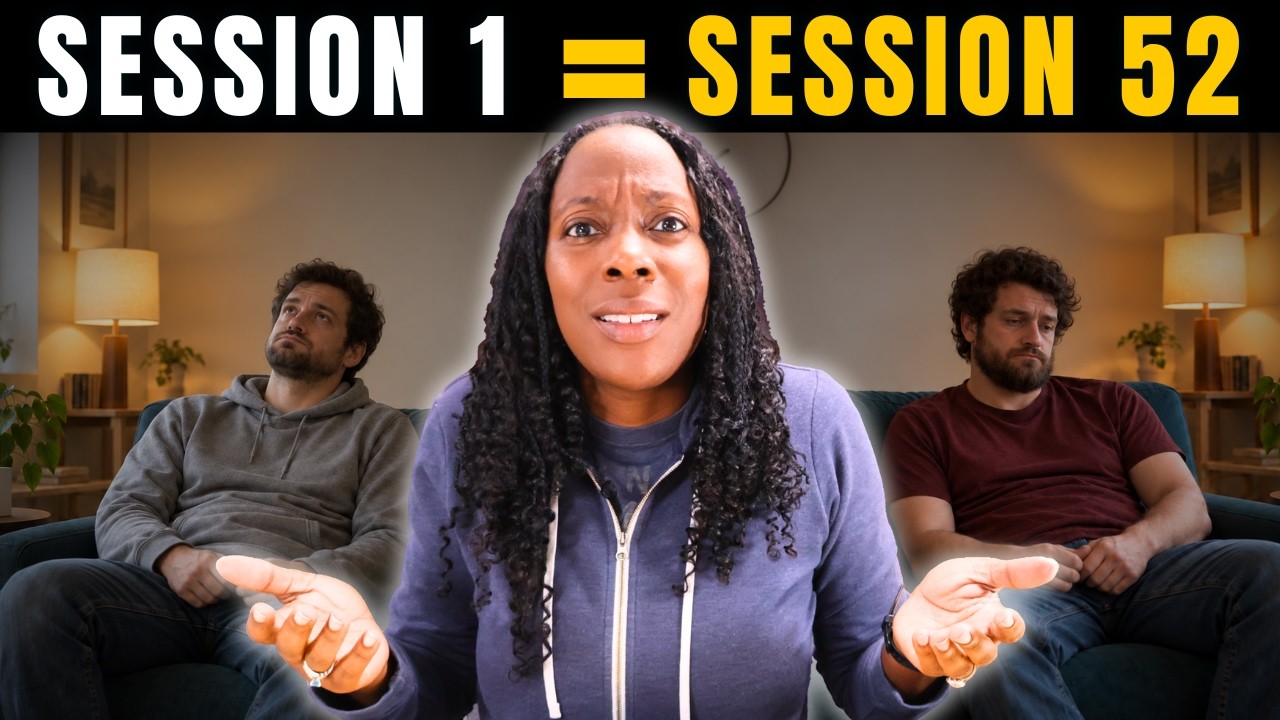
You’ve tried therapy, maybe even three different therapists, and late at night you catch yourself typing “therapy not working for anxiety” into Google. You keep showing up, talking, and hoping something will finally shift. Still, every week feels like another conversation about the same anxiety.
So you start wondering: is therapy failing me, or am I the problem? The honest answer might be uncomfortable, but it also gives you more control than you think.
This post comes from Episode 84 of Block Out the Noise. I’ll walk you through five reasons anxiety therapy sometimes leaves you feeling stuck, how to tell which one is getting in the way, and what to do differently before you give up.
Watch or listen to this episode
Is therapy not working for anxiety, or is something else in the way?
When therapy stalls, most people land on one of two conclusions. Either therapy doesn’t work, or they’re too difficult to help. I don’t want you to leave with either one.
A stalled therapy experience isn’t always your fault. Therapists miss things, relationships become stagnant, and some people need a different treatment or level of care. You also have more control in the process than you may think, and that’s where we’re going to focus.
I think about therapy like being in a car, so each of the five reasons has a car name:
| Reason | What it can look like |
|---|---|
| Autopilot | You show up and wait for your therapist to make the change happen. |
| Stuck in park | You want relief, but you’re not ready to do something different yet. |
| Passenger check | The relationship with your therapist doesn’t feel safe, helpful or fresh anymore. |
| Spinning your wheels | Sessions are full of venting, with little room for feedback or practice. |
| No GPS | You’re having meaningful talks, but nobody knows what progress would look like. |
Reason 1: Autopilot, or waiting for your therapist to drive
I want to start with something I believe deeply as a therapist: change belongs to the client. Your therapist can listen, challenge you, ask questions, offer tools, and help you notice things you’ve missed. Those things do matter, but your therapist can’t own your change for you.
You’re in the driver’s seat, your therapist is sitting in the passenger seat.
Jessica Davis, Block Out the Noise Episode 84
Your therapist might say slow down. They might point out a stop sign you didn’t notice, or warn you about an accident ahead and ask if you want to take another route. They don’t have the steering wheel, though. They don’t control the brakes, and they don’t decide where you go next.
This isn’t just my opinion about therapy. The American Psychological Association puts it plainly in its guide to understanding psychotherapy and how it works: “Psychotherapy isn’t about a psychologist telling you what to do. It’s an active collaboration between you and the psychologist.” The same page encourages people to “be an active, engaged participant in psychotherapy.”
A good therapist might help something click, and a tool might help you respond differently when anxiety shows up. You’re still the person who leaves the session and does something with it.
What autopilot looks like in everyday life
- You leave and forget: The session felt good, but by Tuesday you can’t remember what you talked about or what you planned to try.
- You wait for the breakthrough: You keep hoping your therapist will say the one thing that makes the anxiety disappear.
- You hand over the wheel: You ask your therapist what you should do about your job, your partner or your friend, and you feel stuck when they turn the question back to you.
Owning the steering wheel doesn’t mean you already know where you’re going. It means your therapist supports the process without taking control over it.
Reason 2: Stuck in park, when wanting relief isn’t the same as being ready
Wanting relief and being ready for change sound like the same thing, but they really aren’t.
Jessica Davis, Block Out the Noise Episode 84
You might want the panic attacks to stop. You might want to sleep better, or for your mind to finally quiet down. Of course you do.
Change might ask you to do things that feel harder than the anxiety itself:
- Adjust your habits: like changing your sleep routine.
- Face something you avoid: the conversation, the phone call, the place that makes your chest tight.
- Set a boundary: with a coworker, a friend or someone you love.
- Stop seeking reassurance: like asking “are you sure it’s fine?” one more time.
- Practice a skill: even when you’d rather return to what feels familiar.
Sometimes the familiar problem feels safer than an unfamiliar one. You might wonder, what if my anxiety gets better and I’m still unhappy? What if anxiety isn’t the whole problem? What if getting better changes part of who I am?
This isn’t you wanting to be a victim. That’s fear of change and fear of the unknown. Anxiety has become familiar, even when it hurts.
Here’s the hard truth at the center of this: therapy will not lead to lasting change if you aren’t ready for change. Therapy might help you feel supported, give you insight, and help you slowly become ready. Lasting change happens when you’re willing to do something different.
The stages of change: the psychology behind feeling stuck
There’s a model therapists often use called the stages of change. Knowing the stages can help you figure out where you are right now, so you can stop guessing why nothing is moving. The time frames below come from a medical overview of stages of change theory from the National Library of Medicine.
Here’s how the stages work, in plain words:
- Precontemplation: You’re not planning to change anytime soon. You might not see a problem yet, or you might be in therapy because someone else pushed you to go. The stages of change overview describes this as having “no intention of making a change in the next 6 months.”
- Contemplation: You know something needs to change and you’re seriously thinking about it, but you feel torn. You’re weighing what you might gain against what you might have to give up.
- Preparation: You’re planning to act soon. The same overview says people in this stage “intend to act within the next 30 days.” You might be learning more about anxiety, looking for a therapist, booking an appointment or deciding which habit to change.
- Action: You’re actively changing what you do. You practice a coping skill, set the boundary, follow the new sleep routine, cut back on reassurance or respond differently when anxiety shows up.
- Maintenance: You’re protecting the progress you’ve made and keeping old habits from coming back. The overview notes people typically stay in this stage “between 6 months and 5 years,” which is a good reminder that some changes need ongoing attention.
Slipping back doesn’t erase your progress
A return to an old pattern can happen anywhere in this process. People often call that relapse. It doesn’t erase your progress or mean you failed. It gives you more information about what made the old behavior easier to return to.
The stages of change review agrees. It says change “follows a spiral or a recycling of stages rather than a linear progression” and that “relapse should not be viewed as a failure.”
The point isn’t to label yourself. It’s to ask, where am I right now? Am I thinking about changing, preparing to change, or doing the work change requires?
Reason 3: Passenger check, or is this the right therapist for you?
You might be ready to move and still be sitting beside the wrong person.
A large meta-analysis on the therapy relationship published in the journal Psychotherapy pulled together 295 studies covering more than 30,000 patients. The researchers found a positive link between the therapy relationship and outcomes, and that link stayed consistent across treatment approaches, measures and countries. The relationship isn’t the whole story, but it deserves your attention.
I look at four things:
- Do you have a good relationship with your therapist?
- Do you consistently dread going?
- Do you feel heard?
- Have you been together so long that you’ve plateaued?
Dreading one difficult session doesn’t mean you have the wrong therapist. Therapy can feel uncomfortable because change is uncomfortable. You might leave angry after saying something out loud and realizing what it means.
Anger isn’t automatically a bad sign, and it isn’t proof that therapy worked either. Ask yourself what happened. Did your therapist challenge you respectfully, or did you feel dismissed, pressured or hurt? Does the relationship feel safe enough to talk about it?
Sometimes a therapist has taken you as far as the two of you can go together. That doesn’t make them a bad therapist or mean the relationship failed. Your needs might have changed.
How to know when to change therapists
If the relationship feels safe, talk about it before you leave. You can say, “I feel stuck, I don’t think I’m making progress, and I want to understand why.” That conversation might change the direction of therapy completely, repair something between you, or confirm it’s time to move on.
The APA’s guide on how to find help through seeing a psychologist backs this up: “If you find yourself thinking about discontinuing therapy, talk with your psychologist.” Mayo Clinic’s guide to getting the most out of psychotherapy adds: “If you aren’t comfortable, look for another therapist who can make you feel more at ease.”
If you’ve had three, four or five therapists in a short period of time, pause before choosing the next one. Ask yourself a few questions first:
- What am I looking for? Read their profile and website, and name what helped and what didn’t with past therapists.
- What style fits me? Do you want someone gentle and reflective, or more direct?
- How do I want sessions to feel? Do you want structure and practice between sessions, or more space to process?
Finding the right therapist gets easier when you understand what you need.
Reason 4: Spinning your wheels, when every session is venting
What if you like your therapist? You feel heard, the relationship is strong, and sessions still aren’t moving. Then the problem might be what’s happening inside the hour.
Sometimes people have held in so much that everything tumbles out in therapy. It might be the only place they feel safe enough to say it all.
Others process out loud or speak quickly. None of that means you’re doing therapy wrong. The problem is when every session stays there.
| Venting | Working through it |
|---|---|
| Repeats what happened and why it was upsetting | Challenges your own statements |
| Fills the whole hour with the story | Leaves room for questions and feedback |
| Ends when the session ends | Turns into something you practice during the week |
| Focuses on what went wrong | Notices patterns and asks what belongs to you |
If you talk the entire session and leave your therapist 30 seconds at the end, you might have needed the release. You also didn’t leave much room for your therapist to ask questions, offer feedback, or help you see the situation from another angle. Your therapist doesn’t need to interrupt you every 30 seconds, but therapy needs enough room for conversation.
Practice between sessions matters too. Mayo Clinic’s psychotherapy guide says homework between sessions, like journaling or practicing coping skills, “can help you apply what you’ve learned in the therapy sessions.”
Ask yourself:
- Am I sharing what needs to be discussed?
- Am I leaving room for feedback?
- Am I practicing anything between sessions?
- Am I avoiding a conversation because I’m afraid of how it will feel?
Don’t skip what’s already strong
Therapy spends a lot of time on problems because you came in with something that hurts. If we only study what’s wrong, though, we miss what’s already strong.
This is my clinical view, and other therapists might approach it differently. I believe strength-based work should run underneath the entire therapy process. It helps you name the strengths you have, notice the ones you overlook, and use them to move forward.
Anxiety is part of your experience. It isn’t the full definition of who you are. When you notice a strength, bring it into the room. It gives you and your therapist something solid to build on.
Reason 5: No GPS, and why therapy goals for anxiety matter
There’s one more issue that can make every session feel productive while your life stays the same: you haven’t set a direction.
You can want help without knowing what kind of help you need. Without a clear picture of progress, you and your therapist might have meaningful conversations without knowing whether you’re moving forward.
The APA’s guide to how psychotherapy works describes “collaborative goal-setting” as important “because both of you need to be invested in achieving your goals,” and says you and your psychologist will “assess your progress and determine whether your original goals need to be reformulated or expanded.” In plain language, therapy is more helpful when both people know what they’re working toward.
Ask yourself three questions:
- Where do I want to go?
- What do I want to work on?
- What would progress look like in my actual week?
Then choose one to three goals. I say this as someone who loves a good list of 10 to 15. It feels productive until you’re working on everything and nothing really gets done. Pick one to three, reach one, and then add another if you can.
Here’s what that might look like for an anxious adult:
- At work: “I want to send an email without rereading it ten times.”
- At home: “I want to stop checking my phone for reassurance texts every hour.”
- In relationships: “I want to tell my partner when something bothers me instead of replaying it all night.”
If you want help keeping goals small and realistic, the free 90-Day Courage Challenge cheat sheet walks you through building momentum and staying consistent.
How to get the most out of therapy for anxiety, starting this week
When these issues stay unnamed, you repeat the same session or move from therapist to therapist without understanding what you need. Here’s how to use everything above:
- Pick your reason. Which one sounds most like your experience: autopilot, stuck in park, overdue for a passenger check, spinning your wheels, or moving without a GPS? Choose one.
- Find your stage. Look back at the stages of change and ask where you are right now. Be kind and honest with yourself.
- Choose one to three goals. Use the three GPS questions above and write your answers down.
- Pick one small step for today. Ask yourself, what is one thing I can do today that moves me a little closer?
- Bring it into your next session. You might say, “I’ve been feeling stuck. These are the goals I want to work toward, and I’d like your feedback about what might be getting in the way.”
- Leave room for the answer. Give your therapist time to respond, ask questions and offer another angle.
That conversation might change the direction of therapy completely. It might show that you need more feedback, or reveal that it’s time for another therapist. Your therapist will probably love it.
The APA encourages this kind of honesty in its guide to seeing a psychologist, saying “you should be open with your psychologist if you find yourself feeling ‘stuck’ or lacking direction once you’ve been in therapy awhile.”
If anxiety keeps you stuck outside of therapy too, read why anxiety keeps you stuck and why you can feel stuck in life when everything is fine. For quick tools between sessions, grab the free Anxiety Survival Toolkit.
Therapy not working yet doesn’t mean therapy will never help you.
Jessica Davis, Block Out the Noise Episode 84
It doesn’t mean you’re broken or too difficult to help. You might need a clear direction, a more honest conversation, a different therapist, or a little more readiness to take part. You’re learning how to take ownership of the change while letting someone support you along the way.
Listen to the full episode
In the full episode, I talk through all five reasons in my own words, including the car comparison, the stages of change and how to bring your goals into your next session. Keep moving forward, trust yourself, and never forget you have what it takes to block out the noise.
Questions people ask
Quick reminder: Block Out the Noise is here to support and guide you, but it is not a replacement for talking to someone in real life. If you’re struggling with your mental health, please reach out to a therapist. If you’re in crisis, contact emergency services or a local helpline. You don’t have to go through it alone.