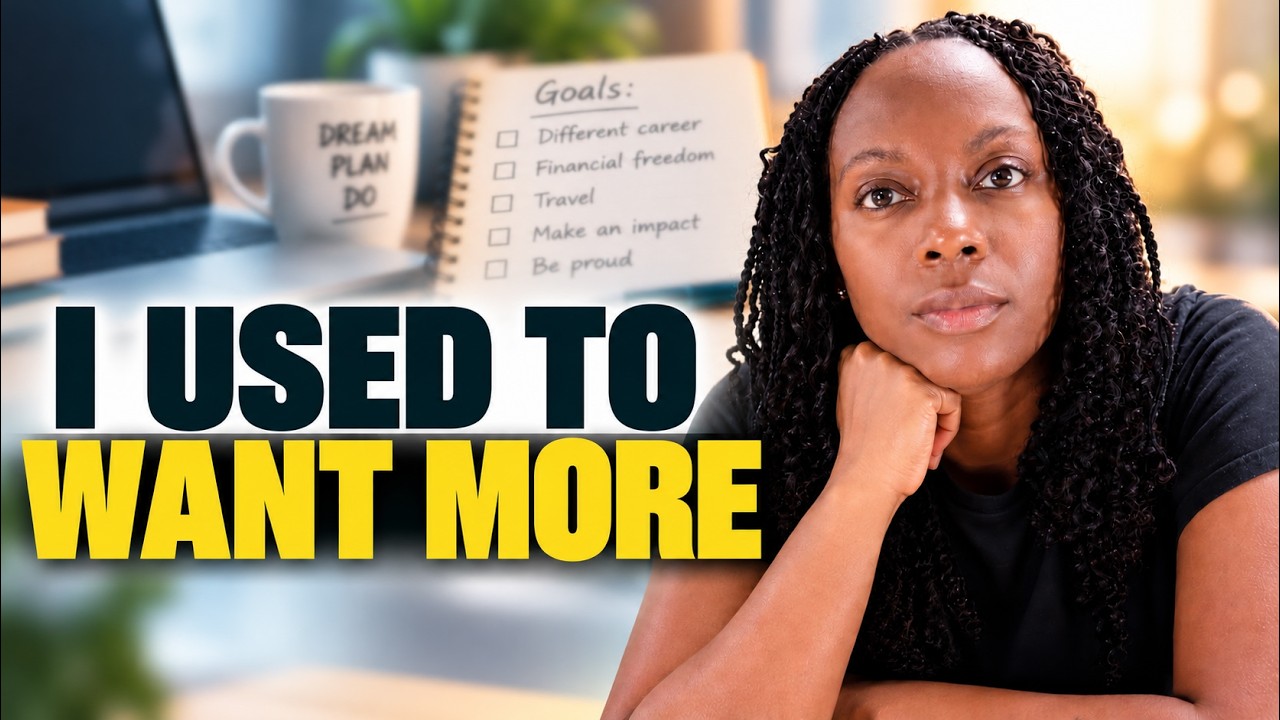
It’s Sunday night, you’re on the couch, and one question keeps circling: why do I feel stuck in life when nothing is actually wrong? You’re thinking about another week of the same job, the same routine and the same conversations about how tired you are of everything.
You don’t hate your life, but you’re not exactly excited about it either. You keep telling yourself things are fine. You have a steady paycheck and real responsibilities, so why would you risk messing that up?
This post comes from Episode 86 of Block Out the Noise, “When Did I Stop Wanting More From Life?” It’s about a quiet kind of anxiety that doesn’t feel like fear at all. We’ll look at why it happens, what the research on uncertainty and avoidance can teach us, how to tell contentment from fear, and one small way to start looking again.
Watch or listen to this episode
Why Do I Feel Stuck in Life When Things Are Fine?
Being dissatisfied doesn’t mean you’re miserable. You get up, you handle your responsibilities, you show up for people, you pay your bills when you can and you get through the week. From the outside, there may not be a single obvious reason to change anything.
Every now and then, though, a little thought slips in: Is this really what I want the next five years to look like? Almost before you finish asking, another thought answers it. “Come on, things could be worse.”
That second thought isn’t completely wrong. Gratitude matters, stability matters and your responsibilities are real. Notice what happened, though: you asked whether something was meaningful to you, then answered with a comparison to how much worse it could be.
Those are two different questions. One is about meaning. The other is about avoiding the worst. If you keep answering the first question with the second, it’s easy to end up feeling stuck without ever deciding to be.
Not being in a terrible situation doesn’t automatically mean you’re in the right situation for this season of your life.
Jessica Davis, Block Out the Noise Episode 86
Comfortable but Not Happy: The Quiet Side of Anxiety
You don’t have to hate what you built to wonder whether you’d like something to change. Feeling comfortable but not happy is one of the ways anxiety hides, because anxiety isn’t always loud. Sometimes the protective habit has become so familiar that the fear is hard to recognize.
You stop looking into options that might lead to uncertainty. That isn’t because you’re weak or have no ambition. The option you already know simply comes with fewer unanswered questions.
You know the frustrating parts of your routine, and you know how to manage them. If you explored a different job, moved, started something on the side, spoke up in a relationship or just changed the way you spend your time, you’d have to deal with questions you can’t answer yet:
- What if I fail?
- What if I regret it?
- What if this affects my family?
- What if I’m not as capable as I think I am?
You can’t always solve those questions in advance. So your mind makes a trade: keep the dissatisfaction you know, and you don’t have to face the uncertainty you don’t. That trade can feel surprisingly reasonable.
One of the biggest costs of anxiety isn’t the opportunities you’ve missed. It’s the opportunities you’ve stopped looking for.
Jessica Davis, Block Out the Noise Episode 86
Why not knowing feels so heavy
Look at those four questions again. Every one of them is about something you can’t know yet. That’s not a coincidence.
A 2020 review on uncertainty and anxiety describes how uncertainty about future events may lead to worry and anxiety. Researchers use the term intolerance of uncertainty for how hard it is for someone to sit with not knowing, and the review calls it a risk factor that shows up across many forms of anxiety.
In plain terms, the more your mind treats “I don’t know how this will turn out” as a problem that must be solved first, the more appealing the familiar option becomes. The familiar job, routine or conversation already has answers, even if you don’t love them.
How Possibilities Quietly Disappear
Picture someone who has talked for years about wanting a different kind of work. Not a huge promotion, just more flexibility, or not spending every Sunday evening dreading the next morning.
One night they mention it to their partner. “I should probably see what’s out there.” They’re exhausted, though, and tomorrow comes early, so they don’t look that night.
The next weekend they think about it again, but they tell themselves the market is probably terrible. Besides, they don’t want to get their hopes up. Eventually, they stop bringing it up.
Nothing dramatic happened. There was no rejection letter, no failed interview and no embarrassing attempt, which means there’s no moment they can point to and say, “That’s when I gave up.” The possibility just faded out of their everyday life.
A decision doesn’t always look like a decision. Sometimes the choice is made by what you repeatedly don’t explore.
Jessica Davis, Block Out the Noise Episode 86
Why avoiding feels so reasonable
Avoidance isn’t a character flaw. A 2022 review in Frontiers in Psychiatry points out that avoidance is highly adaptive in real, acute danger and serves a strong protective function. The same review notes that persistent or excessive fear and unhelpful avoidance are considered key factors in anxiety and stress-related conditions.
That’s the tricky part. The part of you that steers you away from the job listing is using a tool built for danger on something that’s only uncertain. It’s trying to protect you, but what it ends up blocking is information you need.
When you avoid something that makes you uncomfortable, the relief you feel right away can teach you to avoid it again. Every time you skip the exploring, you also skip the chance to learn something new. After a while, “I haven’t looked into it” starts to sound like “there isn’t anything else out there.”
That’s a much smaller world to live in. If that loop sounds familiar, my post on why anxiety keeps you stuck goes deeper.
Is It Normal to Feel Stuck in Life, or Am I Just Content?
Here’s a distinction worth protecting. Staying in a familiar situation isn’t proof of anxiety. You might be exhausted or burned out, or dealing with depression, financial pressure, health concerns, caregiving or a season when keeping things stable truly is your priority.
Low energy can come from more than one place. The National Institute of Mental Health explains that everyone feels sad or low sometimes and those feelings usually pass, while depression is different and can cause symptoms that affect how you feel, think and handle daily activities like sleeping, eating or working. If that sounds more like your season than simple restlessness, it deserves real attention and support.
You might also be content, and that’s not a problem to fix. A bigger life isn’t automatically a better one. What matters is being able to tell the difference between choosing what matters to you and choosing only what feels predictable:
| Choosing what matters to you | Choosing only what feels predictable |
|---|---|
| You looked at the option and decided to stay | You stopped looking at options at all |
| Stability is your priority for this season, on purpose | The unanswered questions feel too big to face |
| Your no is based on something you learned | Your no is based on a guess you never checked |
| You can talk about the other path without tensing up | You change the subject when it comes up |
Feeling stuck now and then is a very human experience. The question isn’t whether you have the feeling. It’s whether fear is quietly making the choice for you.
When the First Step Feels Like a Final Commitment
Psychologists talk about a skill called psychological flexibility. Put simply, it means noticing uncomfortable thoughts and feelings without letting them decide every action, while still making choices connected to what matters to you. The discomfort doesn’t have to disappear before you take a meaningful, manageable step.
A well-known review on psychological flexibility describes it as a set of abilities that includes adapting to what a situation calls for, shifting your approach when a strategy is getting in the way of your life, keeping balance among the parts of life that matter, and staying aware, open and committed to actions that fit your deeply held values. Notice that none of that requires feeling sure first.
When people describe feeling stuck online, one frustration comes up again and again. They think about a small change and their mind jumps five years ahead. Before they’ve even looked at a new job, they’re worrying about how leaving their current one might affect their family.
The first step starts to feel like a final commitment. No wonder exploring feels enormous.
Listen for the shift in how you describe yourself
Over time, the cost gets personal. At first it’s one conversation you never had. Then it’s a subject you stop bringing up. Eventually it shapes the way you describe yourself:
- “I’m not the kind of person who takes risks.”
- “I’m too old to start over.”
- “That’s just not realistic for someone like me.”
Listen to that shift. What started as a choice about a specific situation has turned into a statement about who you are. Once you’ve decided a different future doesn’t fit someone like you, why would you even look for one?
A Real Limit or an Anxious Prediction?
I wouldn’t start by asking, “Am I living the wrong life?” That’s an enormous question, and it can send you straight back into overthinking. Start smaller.
When you picture a reasonable change, what stops you from exploring it? Is it a limit you can name, or an uncomfortable prediction about what might happen if you try? Both deserve your attention, but they call for different responses. Say the change is taking a class or learning a skill you keep thinking about:
| What you tell yourself | What it is | What it calls for |
|---|---|---|
| “I can’t afford the course this month.” | A real constraint | Planning |
| “I’ll probably be the oldest person there, and everyone will think I’m ridiculous.” | A prediction | Checking whether you’re treating an imagined outcome as if it already happened |
Here’s a simple way to sort your own reasons:
- Picture one reasonable change. Not a whole new life, just one thing you keep coming back to.
- Write down what stops you. Get every reason out of your head and onto paper, even the ones that feel silly.
- Label each one. Is it a limit you can name, like money, time or a real responsibility, or a prediction about how it might go?
- Give each label its own response. A constraint invites planning, like saving for a few months or asking about a payment plan. A prediction invites a question: am I treating this imagined outcome as if it already happened?
The goal isn’t to override every concern. It’s to give yourself enough space to decide, instead of automatically backing away.
How to Stop Feeling Stuck in Life: One Small Piece of Proof
If you want to know how to stop feeling stuck in life, don’t start by changing your whole life. Start by giving yourself one small piece of proof that you can explore something different. The principle behind it is simple: exploring is not committing.
- Choose one direction. Not ten things to fix, just one part of your life that matters to you. Maybe you want a job that leaves you with more energy, you miss being creative or you want to feel connected to your partner again. You’re not deciding what your life should look like five years from now.
- Choose one reversible action. Looking at job openings is not quitting your job. Asking what a class costs is not enrolling. Suggesting a walk with your partner isn’t a promise that one conversation will fix everything.
- Let that action give you real information. Spend 20 minutes researching a flexible schedule. Pick up the instrument you haven’t played in years and try it for 10 minutes. Have the small conversation you’ve been putting off, when it’s appropriate and safe.
- Ask what you learned. Not whether you fixed anything, just what you know now that you didn’t know before.
This is where people get stuck: they imagine the final commitment before they’ve gathered the first piece of information. So tell yourself, “I’m not deciding whether to change my life. I’m deciding whether this possibility is worth exploring.”
Every result counts
You might find out the roles you’re considering don’t pay enough. That’s real information, and it gives you a real constraint to work with. You might discover you miss your hobby more than you thought, or that you don’t. None of those outcomes are failure.
The win isn’t fixing your life in 20 minutes. It’s replacing an assumption with something you learned by acting. The real skill you’re practicing is taking a manageable step before you have certainty, which is very different from spending another evening thinking about what you might do someday.
If you’re thinking, “I have people depending on me,” you’re right to consider that. The point isn’t to gamble your family’s stability. It’s to find out whether you have more options than the ones you’ve automatically ruled out.
What to Do When Life Feels Stuck on a Sunday Night
So what do you do when life feels stuck and Sunday night rolls around again? Monday still comes tomorrow. Your responsibilities haven’t vanished, and the week doesn’t suddenly look different.
This time, your next step isn’t a dramatic promise. It’s one piece of proof: one direction that matters, one manageable action and one thing you’ve learned. If you’d like help turning small steps into a habit, the free 90-Day Courage Challenge cheat sheet walks you through setting realistic goals and staying consistent.
You might discover the option you considered isn’t right for you. You may decide to keep the life you have, and that’s a meaningful result when it’s a choice you made after looking honestly. You might also find that a possibility you’ve dismissed for years is worth another conversation.
Either way, you don’t have to let uncertainty decide which possibilities you’re allowed to explore. If anxiety or low mood is seriously affecting your daily life, professional support can help you sort through it. The free Anxiety Survival Toolkit also has a 3-minute emergency reset and 75 coping strategies for the nights your mind races ahead.
Hear the Whole Sunday Night Conversation
In the full episode I walk through that Sunday night feeling, why “things could be worse” answers the wrong question, and how to tell a real limit from an anxious prediction. You don’t need your entire future figured out. You just need an experience that reminds you you’re still able to choose.
Questions people ask about feeling stuck
Quick reminder: Block Out the Noise is here to support and guide you, but it is not a replacement for talking to someone in real life. If you’re struggling with your mental health, please reach out to a therapist. If you’re in crisis, contact emergency services or a local helpline. You don’t have to go through it alone.