
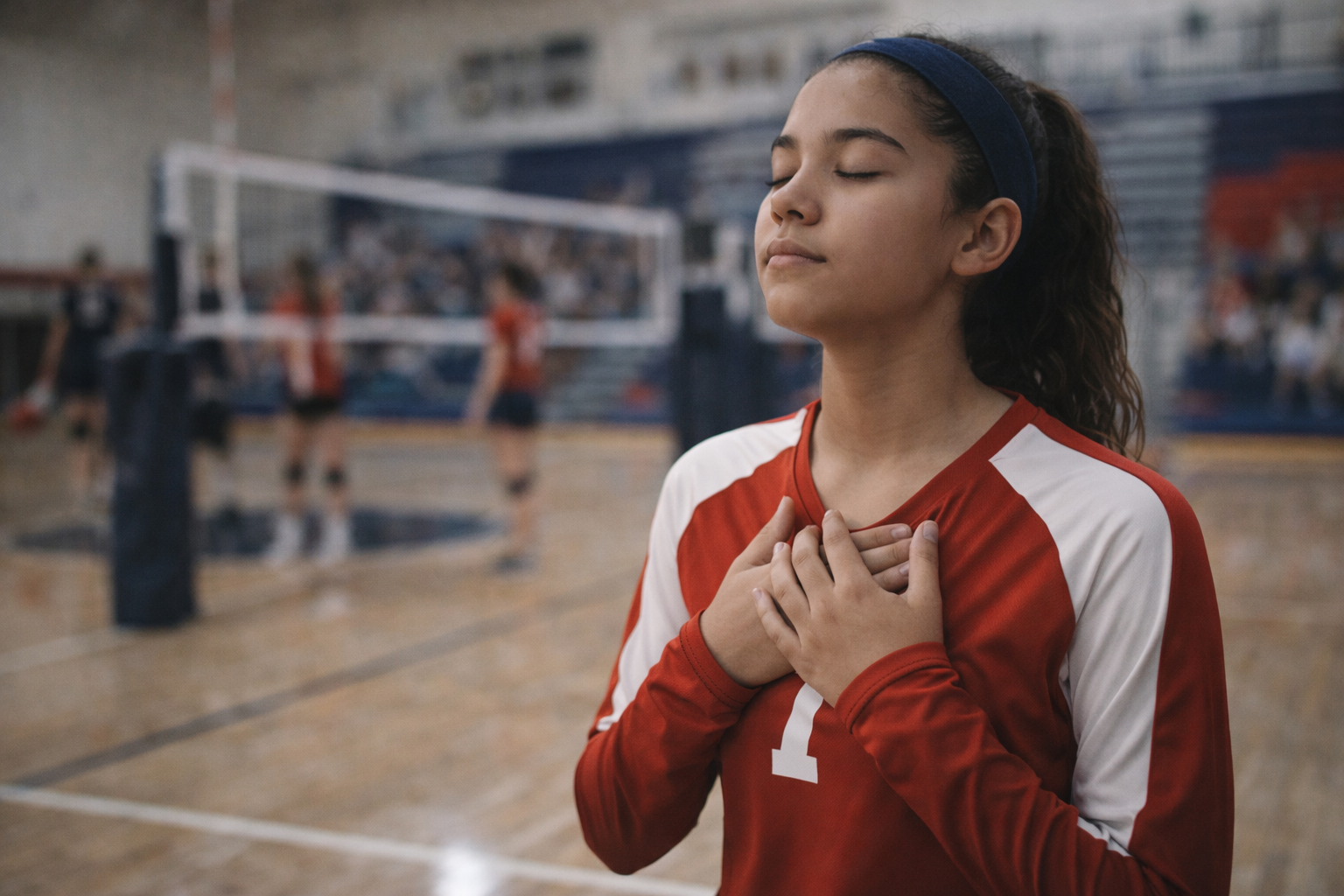
Ever Feel Like Your Brain Becomes Your Biggest Opponent on Game Day?
Sports anxiety is real, and if you have ever felt it, you know exactly what I mean. You have practiced. You have put in the work. You know the plays, the drills, the skills. But the moment game day hits, everything changes.
Your heart races. Your stomach flips. Your hands start to shake. And suddenly you are not just playing the game, you are fighting your own mind.
- What if I mess up?
- What if I let my teammates down?
- What if everything I have worked for still is not enough?
If that spiral sounds familiar, you are not alone. And you are not weak for feeling it. Sports anxiety does not mean you are not ready. It means you care. Today I want to walk you through a four-step routine designed to help you feel calm, focused, and ready to show up like the athlete you are.
I am Jessica Davis, a licensed therapist, mindset coach for teens and young adults, and the creator of the C.O.U.R.A.G.E. Method. In Episode 8 of Block Out the Noise, I share the exact mental performance routine that elite athletes use, and how you can make it yours before your next game, competition, or performance.
👇 Here is what we will cover. Jump to what you need most or read through at your own pace.
Sports Anxiety Does Not Mean You Are Weak
Let me say this clearly before we go any further. Sports anxiety does not mean you are weak. It means you care.
And you would be in incredible company. Simone Biles, one of the most decorated gymnasts of all time, has spoken openly about putting mental health first because without it, she said, you are not going to enjoy your sport. Michael Phelps talked about the weight of expectations and how anxiety and depression affected him for years, even while winning gold medals. Naomi Osaka stepped away from tournaments entirely to protect her wellbeing.
These are world-class athletes. And they still struggled.
The truth is that at some point, every athlete is going to face some version of anxiety or a mindset challenge. Because when you care about something, when you have trained for it, dreamed about it, and pushed yourself to the edge for it, the mental weight that comes with that is real.
Sports anxiety is not about a lack of skill. It is about managing the mental game that comes alongside the physical one.
The Fear Nobody Talks About
Here is something I want to share with you that I do not talk about often. Growing up, I was a pretty good basketball player. But I did not believe I deserved recognition for it. I told myself I was just supposed to play a supporting role, small, but still seen. Not really seen.
Looking back, I know now that mindset was not humility. It was fear. Fear of not feeling supported. Fear of standing out. Fear of the expectations that come with playing a great game.
And sometimes it is not the fear of failure that holds us back. It is the fear of success.
If you are in that place right now, afraid to show your full talent, unsure if you are good enough, letting nerves take over your performance, what I am about to share is for you. Because the routine I am going to walk you through does not just apply to sports. The resilience, the focus, the mental discipline you build as an athlete? Those skills show up everywhere in your life.
Step One: Lock In Your Pre-Game Ritual
The first step to managing sports anxiety is creating a pre-game ritual, two to three consistent actions that calm your body and tell your brain you are ready.
It might look like:
- Putting on your gear in the same order every time
- Listening to a specific playlist that gets you in the zone
- Doing a short warmup routine you have memorized
Serena Williams ties her shoes a specific way before every match. Tom Brady has a detailed pre-game routine that includes body preparation, mental visualization, and breath work. He has said these rituals help him feel mentally locked in before every game.
These small actions send a signal to your nervous system: we have done this before, we are safe, we are ready. The more consistent the ritual, the stronger that signal becomes.
“It is not about the ritual itself. It is about what the ritual tells your brain.”
Start small. Pick one thing you can do before every practice this week and make it the same every single time. Build from there.
Step Two: Visualize Like a Pro
Two to three minutes of visualization before a game can change how your body responds when the pressure hits.
This is not daydreaming. This is a deliberate mental practice used by some of the greatest athletes in the world.
Jack Nicklaus, one of the greatest golfers ever, said he saw every shot before he took it. Kobe Bryant mentally rehearsed entire games, the crowd, the plays, the pressure, so that by the time he stepped on the court, it already felt familiar. He once said: “Visualization is the key to success. You have to see it first before it becomes a reality.”
Your brain responds to mental practice almost as powerfully as physical practice. So before your next game, close your eyes and picture yourself:
- Making the play with confidence
- Communicating well with your team
- Recovering from a mistake with focus instead of frustration
The more vividly you can see it, the more your body believes it is possible.
Step Three: Create a Power Statement
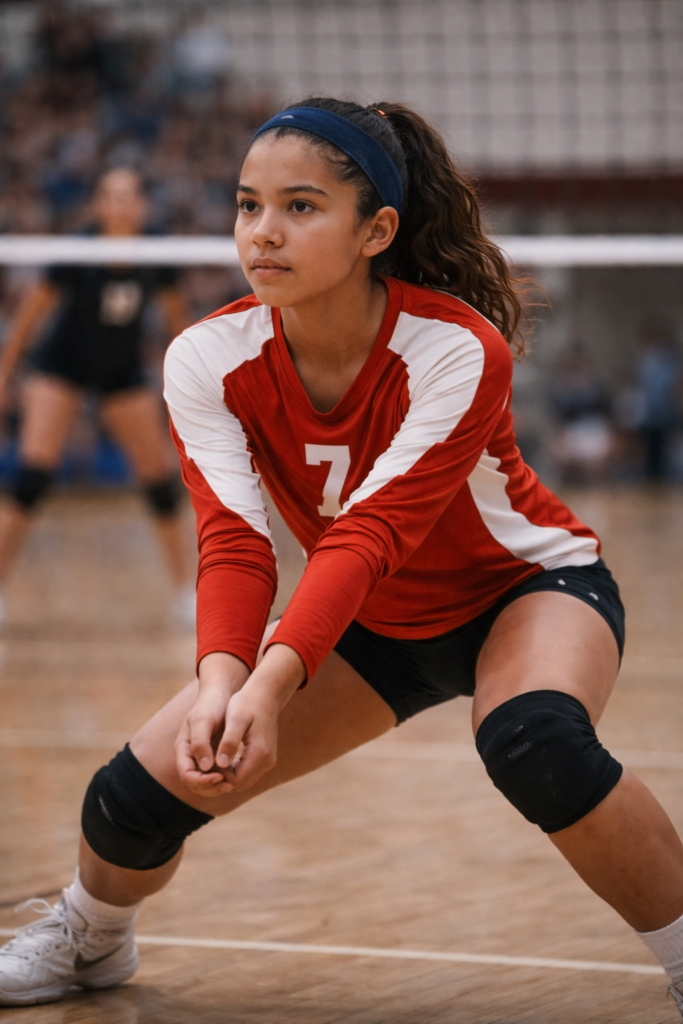
A power statement is a short phrase you repeat to yourself before and even during competition. Something that brings you back to yourself when sports anxiety starts to take over.
Some examples:
- I have done the work. I trust myself.
- Breathe. Focus. Let’s go.
- I belong here.
Olympic sprinter Allyson Felix used a personal mantra to silence self-doubt, not just on the track but in life. Rafael Nadal is known for using specific phrases and rituals before each serve to stay mentally present.
Your voice is the one you hear the most. Make sure it is cheering you on.
Choose one phrase this week. Write it on your wrist before practice. Say it before you walk onto the field. Make it yours.
“Anxiety likes to make you think you are not ready. But really, you just care. That caring is not a weakness. It is proof that this matters to you.”, Jessica Davis
Step Four: Focus on the Next Play
Mistakes will happen. That is not a maybe, that is a promise. The key is not avoiding them. It is not letting them pull you out of the game.
When something goes wrong, here is what I want you to do. Acknowledge it. Take one breath. Then focus entirely on the next play.
Novak Djokovic has said he had to learn to forgive himself quickly after every point. Every second he stayed frustrated was a second he was not present for what came next. Peyton Manning’s teams were known for their “next play” mentality, dwelling on what already happened only leads to more mistakes.
“You don’t win games by being perfect. You win them by staying present.”
One athlete I worked with struggled deeply with sports anxiety. After a bad play, she would spiral, replaying it, criticizing herself, losing focus. We worked on this one practice: one breath, then the next play. It took time. But eventually she told me that learning to let go of the last moment was the thing that changed her performance the most.
You do not have to be perfect. You just have to keep showing up for the next moment.
A Question Worth Sitting With
Before your next game or practice, ask yourself this: what is one thing I want to feel more of when I compete? Confidence? Calm? Focus?
Then ask: which step from today can help me build that?
Pick one tool. Practice it this week, not just in games but in practice, in tough school days, in moments when life feels like it is asking too much. Because this is not just about sports. It is about showing up in your life with the same focus and care you bring to the game.
Key Takeaways
- Sports anxiety does not mean you are weak. It means you care about something that matters to you.
- Even world-class athletes like Simone Biles, Michael Phelps, and Naomi Osaka have struggled with performance anxiety
- A consistent pre-game ritual signals to your brain that you are safe and ready
- Visualization is a proven mental performance tool used by elite athletes across every sport
- A personal power statement gives you something to come back to when anxiety gets loud
- The “next play” mindset, one breath, let it go, move forward, is one of the most powerful tools in managing mistakes under pressure
Topics Covered in This Episode
- What sports anxiety actually feels like and why it happens
- Why caring deeply about your sport makes anxiety more likely, not less
- How elite athletes manage the mental side of competition
- Step one: building a pre-game ritual that signals confidence to your brain
- Step two: using visualization the way Kobe Bryant and Jack Nicklaus did
- Step three: creating a personal power statement that keeps you grounded
- Step four: the next play mindset and how to recover from mistakes quickly
- How these tools apply beyond sports to every area of your life
✨ Want something to hold onto? The free Anxiety Survival Toolkit is packed with practical tools for when anxiety and self-doubt take over, on the field and off it.
Listen to the Full Episode
The four steps are here, but hearing them in the episode hits differently. I go deeper into each one and share more about my own experience as an athlete that did not make it into this post. Listen to Episode 8 of Block Out the Noise and grab the free Anxiety Survival Toolkit while you are there.
Final Thoughts: You Are Not Just an Athlete. You Are a Whole Person.
Sports anxiety wants you to believe that your worth lives in your performance. That a bad game means something about who you are. That if you mess up when it counts, it counts against you as a person.
But that is not true. And deep down, you already know it.
The goal was never perfection. The goal was growth. The resilience you build every time you show up nervous and compete anyway, every time you make a mistake and choose the next play anyway, every time you anchor yourself before walking onto the field, that is the real win. That is what lasts long after the season ends.
The skills you are building right now, focus, self-compassion, the ability to bounce back, those do not stay on the field. They follow you everywhere.
So go out there. Use the routine. Trust your preparation. And remember that every great athlete you admire has stood exactly where you are standing right now, heart pounding, and chose to play anyway.
If this episode gave you something to try before your next game, share it with a teammate who might need it too. And subscribe to Block Out the Noise so you do not miss what is coming next.
Until next time ,
Keep moving forward. Trust yourself.
And never forget: You have what it takes to block out the noise.
FAQs About Sports Anxiety in
Teens and Young Adults
This post is intended to offer support and general information, not to replace professional mental health care. If you are struggling, please reach out to a licensed therapist. If you are in crisis, contact emergency services or a local helpline. You do not have to go through it alone.